Wednesday, December 12, 2007

Dadaist


Critics say that the dada movement is the worst thing that happened in the history of art; a reviewer of American Art News quoted,"The Dada philosophy is the sickest, most paralyzing and most destructive thing that has ever originated from the brain of man." - which I do not deny entirely, as it is intended to be against the classical, or traditional forms of art. It's intended to be as grotesque as possible to deny art, which in result brought major critique in the art world and of artist who take themselves way too seriously. Their reaction is understandable as they took exact opposite turn from art-they made art look ugly, and offensive instead of aesthetically pleasing.

Iconography


Symbol is simply put a concrete object which represent an idea or meaning. Road signs uses shapes, colors and forms to communicate set rules with the drivers easily. It is also used on maps where symbols indicate a category of interest. Religions make symbols and icons to visually represent their identity.
An icon is an image, picture or representation that stands for an object. Icon also takes stance of symbolism where name, face, or a person who has a certain quality or well known significance represent something greater, like religion, political or econimic beliefs.
Sign is an entity that represents another entity. It signifies meanings and other subjects. Types of signs include medical sign, mathematics, information, traffic sign, linguistics,and astrology.
Logo is a graphical element that uses icon, sign and symbol with the logotype- it is intended for the people to recognize their product or company fast, and build trust and interest.


source: http://en.wikipedia.org

Friday, November 2, 2007

Performance Art Starts Now

The first activity we did was very short, and quite awkward. Well, I suppose this activity was meant to be something awkward. It wasn't a challenging activity, just a small performance for the introduction of the subject, to release tensions and get warmed up a bit before the actual. The mirror activity made me laugh too much, because it was weird making faces at someone on to the mirror. However, it made me think, yeah, wasn't there any cases when someone made fun of me in the back, and I did not realise they did? How did that make me feel? Well, to that I say it wasn't a pleasant feeling. While I felt the mirror activity had some meaning, the shaking hands activity seemed shallow. I just couldn't understand what all this was about. But overall, I wasn't pressured to be perfect, so it wasn't a big deal to act however I wanted.
When ever I performed infront of the people, the very common reaction to that was getting nervous. I used to get butterflies in my stomach and felt like fainting. I think my shyness was to the extreme side as I was younger. I mean, what if I fail and perform badly in front of the crowd and get laughed at, and also let down the others? But now to think of it, these feelings and unecessary; I think these thoughts comes from the desire to be admired, wanting to be a perfectionist in front of everybody, which I'm not. In order to perform without feeling pressured I have to be able to put away these thoughts and just, be my self. The word confidence must be describing about those people who accept themselves of who they are, and thus is comfortable to expose one self, even in embarrassing moments. Thus, from this subject, I expect to be more confident about myself, and feel comfortable performing in front of the crowd.

Thursday, November 1, 2007

Expansion of Museums

Some facts of the two articles are much similar-both articles speculate that museums today are in a process of expanding it's size for various reasons, like to introduce more artists and their artworks thus atrracting more people and tourists. However, they point out that expansion of museums may sound impressive, but there are several negative aftermath to the renovation- it may cause the boards and managers to pay not much attention to important, but small details like maintaining the artworks or helping the visitors fully understand the theme and their unique meaning. Now that new modern architecture and style are common and available, the art museumss will tend to care too much about the outer appearance(result of centralization on profit) than to really focus on the idea of inner beauty.
The future of museums doesn't seem stable; recently, a new virtual art museum is constructing it's way to the world of URL, which situates the museums in the verge of extinction. Seeing the new technology stepping into the classical world of art brings out questions and issues from a group of people concerned about the idea of authenticity. When trying to admire an artwork through digital just doesn't look the same, as much people do agree-which may be the result of the artwork's every little morsals of colors and details converting to mere digits of pixels-or the very presence of the artists who created it are lost. In that sense, museums are essential in expiriencing the real art work and finding the truth through them.
Though it might be that museums are damned in the near future by that wonderful term, technology, there still is hope for some other types of museums-many will be those that fits the general public's interests.

Thursday, October 18, 2007

Gastalt


Rooted from the theory of Visual Perception meaning that people tend to put visual elements to one whole piece when certain characters are applied,gestalt is simply trenslated, " unified whole".
There are many principles in which the theory applies; the principle of similarity is when an object looks similar to one another, thus making the viewers believe it is one whole group or pattern. In this term, anonmally meanings that something is out of the similarity.
The principle of continuism is when the eye follows an object and move through another object.
Closure happens when an object is not complete, or is not completely enclosed. When people see enough information or character of an object, they unknowingly fill the missing places.
Proximity is the percievence of whole when the objects are put closely together, creating unity.
Figure and ground are much related principles. Figure is defined as shape, sillouette or form, whileas the ground is what surrounds it.

Source from : http://graphicdesign.spokanefalls.edu
The Gestalt Principles

Thursday, October 11, 2007

Duchamp The Large Glass


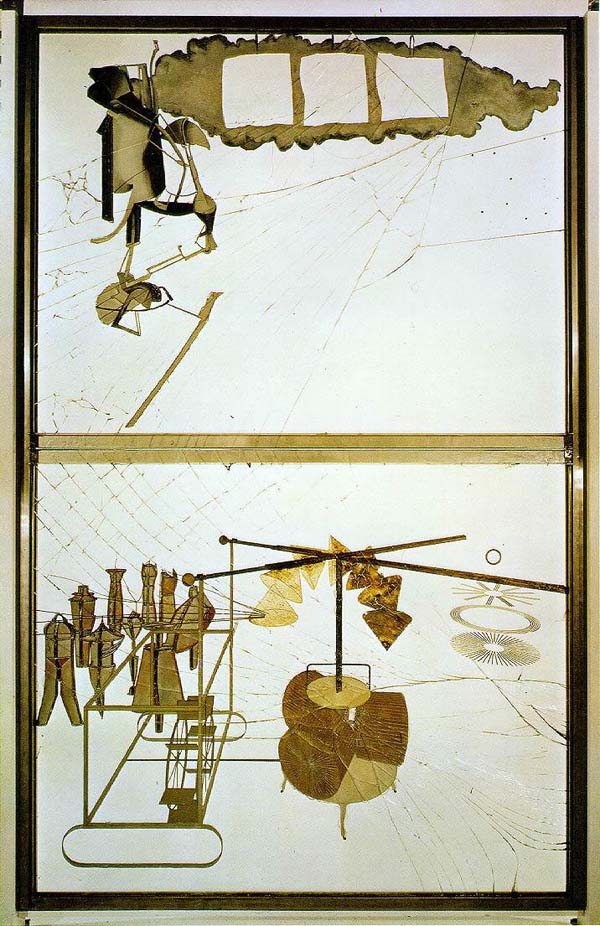
This large art piece is very peculiar in style and design. The whole work is devided into two window panels; the top one titled, "The Bride Stripped Bare by Her Bachelors" has a simplistic space to it. The only object that exsists are the seemingly resemblant three windows. The "bride" looks thin, mechanical and unnatural- not just because it is not a realistic painting, but how the bride looks cold, hard,eerie, and almost, grotesque. I use this word to describe her, as her features are described in a weird way. Her long pointy face gives off the image of hardness or senseless character,which is more emphasized by not having basic facial features. Her long neck is very uncanny, and how the back is humped to a weird arch while her shoulders and arms are angled outward shows an uneasy body composition. Her hip consists of an unreconizable object of which the long, wire or insect like legs even doubles her weirdness. All these attributes makes her look inhuman, like an alien, like a voodoo doll, which almost might suggest the negative character. I cannot identify the object that's mounted on the bride's back, but it seems to resemble burden, supression, deprived of freedom. Maybe she is worried about the future after marriage, the experiences of love, hate, sex,and children.
The lower panel titled, "Bachelor Apparatus" has more mechanical objects within the space, in contrast to the top panel. The middle object, or as it is the chocolate grinder which looks like three drums attatched together. The pole which connects to it seem to make the watermill function, probably connected to the nine bachelors which every one of them looks like clothes on a hanger. The object in the far right seems like disoriented object which may symbolize seperation, and the desire of unity.
The artwork might suggest that the brides has to deal with the responsibility that follows sex, the baby. I think that is why there is one bride drawn in the whole work while there are nine bachelors in the other, signifying the mentality of two genders, mere idea that every men is simple in terms of craving for sex and getting sex, but women although they want the same, they have to deal with pregnancy which brings up guilt and responsibility- having sex is has more complicated out come to women. Depicting one woman here symbolizes this complexity.
Duchamp describes his work to be one of the major artwork, due to the large scale and the time it took to finnish while it was developing slowly. It is quite big, which is over 9 feet tall. He also created a book to accompany the artwork, in order to let the viewers understand what it is before they even start visual critique.

Image from http://www.beatmuseum.org/duchamp/images/bride.jpg

Friday, September 28, 2007

PATTERRRRRNS


The wall papers, floor tiles,and textiles are much needed necessities among the people all over the world. Especially with tiles and textiles, these things developed through out the time, and as art was growing among the cultures, also their style and decorative function followed.
he patterns, I've realized are different by countries. It may be effected mostly by their environment- geographical location which has pros and cons of what resources they provide. For example, Islamic textiles were most colored with brown, red, ochre the earthy colors and dark greens. They had intricate designs of leaves, pomegranates,and some other flowers that are native to their own land. Cottons and wools are natural resources on their land, enabling them to develop complex technology in creating textiles. Nations like Islam-Egypt,Rome,China etc-which has experienced a long history also had a strong growth of culture. Patterns, in a way, are the symbolism of culture, as it is all mathematical, making it a complex element.
Patterns all follows and repeats an underlying single or more pattern in methodological way. This is true as it is clearly shown by nature. the cells and minerals that consists in the very earth, the appearance or forms of cloud, fire, water, or the most simplest things like daisies all are forms of pattern. Patterns also has it's own 'pattern' in it self. Some are just simply same repeated pattern, or there can be structures of irregularities.
In conclusion, the patterns in which the human makes are mere copies and inspirations derived from nature, which is the amazing creation of a being so much bigger and complex then us.